
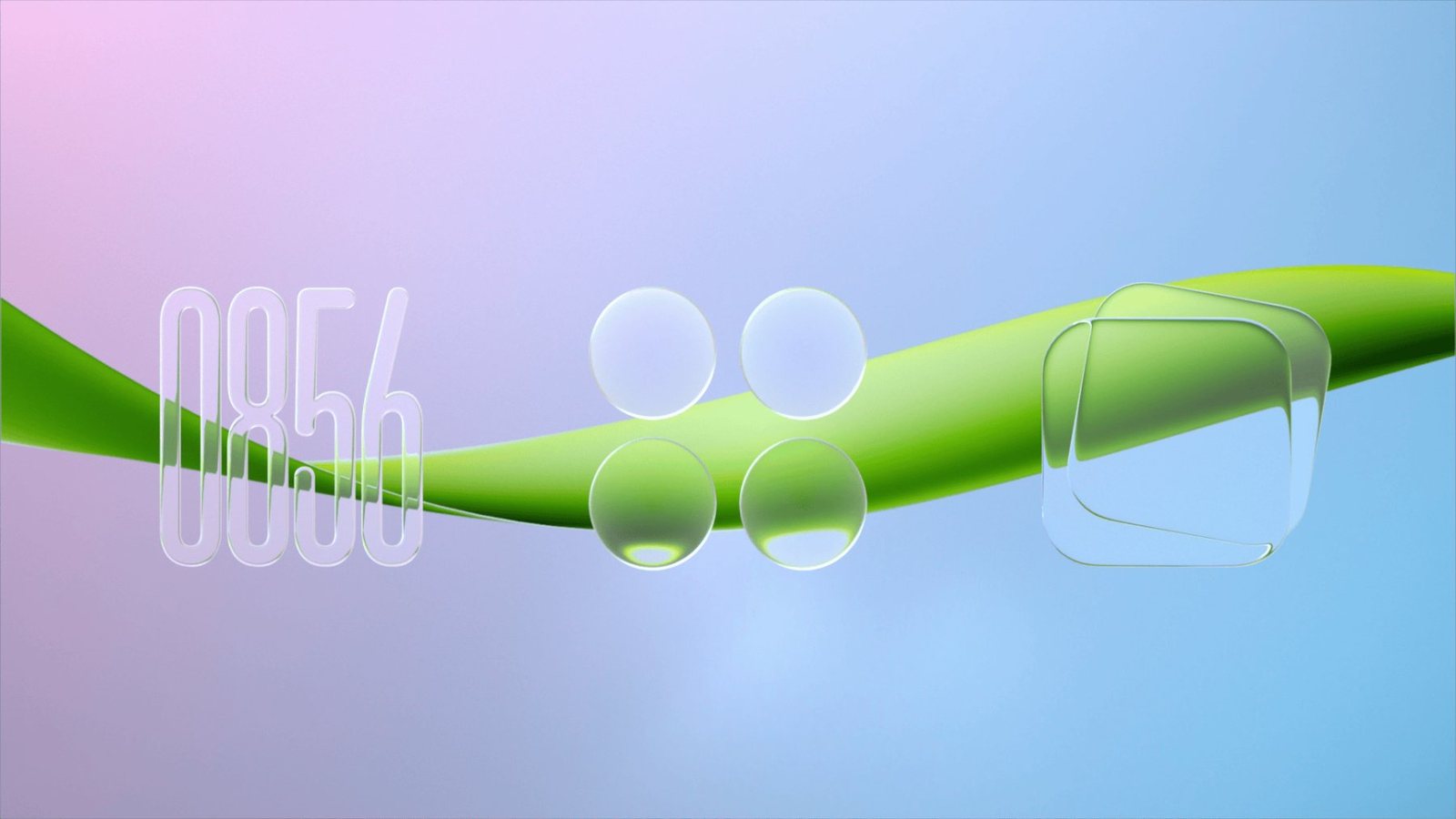
Pull down from the top of a phone running HyperOS 4 and the control centre arrives frosted. The wallpaper blurs behind it, the edges catch a little light, and for half a second it is hard not to think of Apple. Then you put your thumb on a slider and drag, and the illusion goes. It moves like a sheet of acrylic in a frame: it slides, it stops, it does not give.
That small moment is most of what I want to say about Xiaomi's new design, and I will come back to it. First, the part most people are actually searching for, which is when it reaches their phone.
Where HyperOS 4 has got to
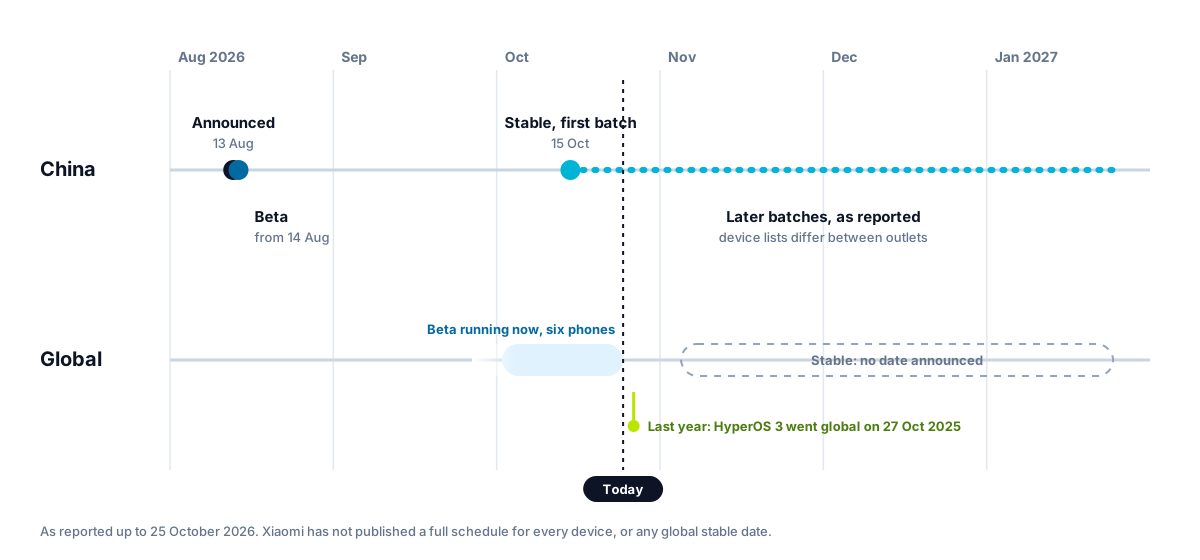
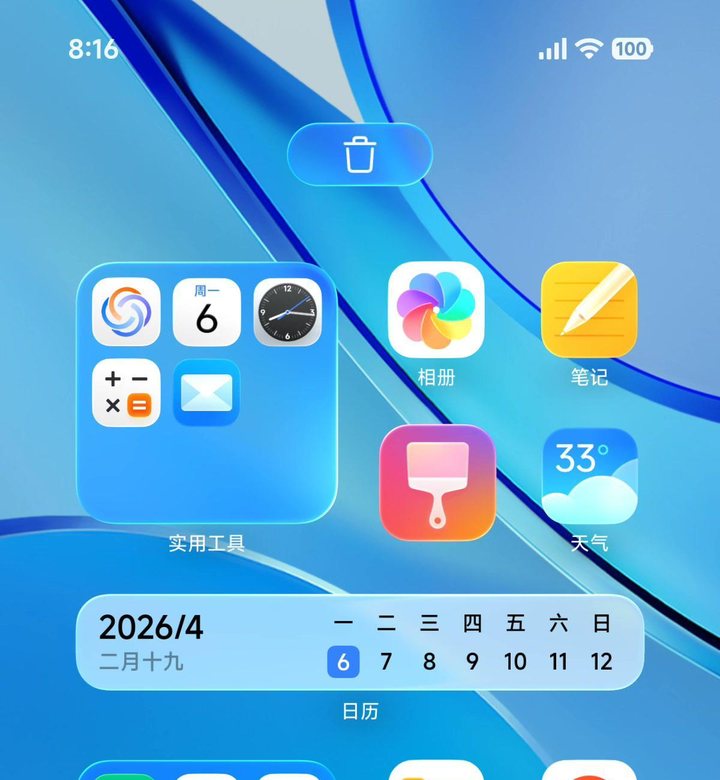
Xiaomi unveiled HyperOS 4, built on Android 17, in China on 13 August, and a beta began the next day on its newest phones and tablets. The headline is a redesign Xiaomi calls Soft Light Glass: translucent panels, blur and lighting across the control centre, menus, widgets and folders. On its HyperOS account on Weibo, as Notebookcheck reported, Xiaomi said the effect "needs further optimization" and would at first be limited to phones with a Snapdragon 8 Elite or newer, a Dimensity 9500 or newer, or Xiaomi's own XRING O1, with older models such as the Redmi K70 and Xiaomi 13 to follow later.
In China, the stable release started on 15 October, in batches, beginning with the Xiaomi 17 series, Redmi's K flagships and the Xiaomi Pad 8 tablets, according to Gizchina. Later batches are being reported through to January 2027, but the device lists differ from one outlet to the next, and Xiaomi has not published a complete timeline for every model. If your phone is not a 2026 flagship, the honest answer is "later this year or early next," and anyone giving you a precise date is guessing.
Globally, there is no stable date at all yet. A global beta is running on six phones, the Xiaomi 17, 17 Ultra, 15, 15 Ultra, 17T and 17T Pro, but a beta place is not a promise of when the finished update lands. The only useful guide is last year. The global stable rollout of HyperOS 3 began on 27 October 2025 with the Xiaomi 15T series, GSMArena reported, a few weeks after China. If Xiaomi keeps to that rhythm, flagships outside China might see HyperOS 4 in late November or December. That is our reading of a pattern, not anything Xiaomi has said.
Check for the update in your phone's own settings, under About phone and the HyperOS version, and wait for it there. The sites offering HyperOS 4 downloads for your model ahead of the official rollout are the fastest way to a phone that will not take the next real update.
It has the look, not the give
Now back to the slider. Apple introduced Liquid Glass in June 2025 and described it, in its own announcement, as a material that "behaves like glass in the real world" and "dynamically reacts to movement with specular highlights," with controls that "dynamically morph." Whatever you think of how it looks, and plenty of people have opinions about its legibility, the part Apple got right is the behaviour. Slide your thumb along a tab bar on an iPhone and the glass under it stretches toward your finger, swells a little, and settles when you let go. It has weight and a bit of give. It feels like it is made of something.
Soft Light Glass borrows the surface and stops there. The blur is good, the tint is tasteful, and the light along the edges is convincing in a still screenshot. But the moment you touch it, it moves the way HyperOS has always moved. Panels slide in whole. Controls travel without deforming. Nothing stretches, nothing gathers, nothing springs back. It is glass as a finish, painted onto the old physics.
It looks like glass you could press into. It moves like glass in a frame.
Which sounds precious, but it is not a small thing. A material that looks soft and moves rigid sends your hand two different messages. The eye says this will yield; the thumb finds that it does not. You do not consciously notice, but you feel it, and over a day of hundreds of swipes it is the difference between an interface that feels alive and one that feels like a very good skin. The behaviour is the design. The look is the advert for it.
Why Xiaomi might have stopped short
To be fair to Xiaomi, there are reasons it may have chosen the stiffer version, and some of them are good ones. Real-time deformation costs graphics power and battery, and Xiaomi sells phones from flagships down to some of the cheapest Redmis on the market. Its own note that the effect needs optimisation, and the decision to limit it to the newest chips at first, read like a company that knows how expensive this is to run. A glass that does not stretch but runs smoothly on a mid-range phone is a defensible trade, even if it is not the one I would have made.
It is also the first version. HyperOS has changed a great deal between releases before, and the elasticity may simply be the next thing on the list. I hope it is, because the frost is already there. What is missing is the reason the frost exists: a material that answers your touch.
For now, if you are choosing a phone on the strength of the new look, judge it in your hand and not in a screenshot. In a still image, the two are almost the same. Under your thumb, they are not.
- HyperOS 4 is built on Android 17. Xiaomi unveiled it in China on 13 August 2026, and the beta began the next day.
- The stable release started in China on 15 October, in batches, beginning with the Xiaomi 17 series, Redmi's K flagships and the Xiaomi Pad 8. Later batches are reported through January 2027.
- There is no global stable date yet. Last year, HyperOS 3 went global on 27 October 2025, a few weeks after China.
- The Soft Light Glass effect is limited at first to Snapdragon 8 Elite, Dimensity 9500 and XRING O1 class chips or newer, with older phones promised later.
- It has Liquid Glass's look but not its behaviour. Nothing stretches or springs back under your thumb, and that is where Apple's version earns its keep.
Frequently asked questions
When will HyperOS 4 come to global Xiaomi phones?
Xiaomi has not announced a global stable date. A global beta is running on the Xiaomi 17, 17 Ultra, 15, 15 Ultra, 17T and 17T Pro. Last year HyperOS 3 began its global rollout on 27 October 2025, a few weeks after China, so late 2026 is plausible for flagships, but that is an estimate, not a Xiaomi date.
When did HyperOS 4 start rolling out in China?
On 15 October 2026, in batches, starting with the Xiaomi 17 series, Redmi K flagships and the Xiaomi Pad 8 tablets. Later batches are reported through January 2027.
Which phones get the Soft Light Glass effect?
At first, phones with a Snapdragon 8 Elite or newer, a Dimensity 9500 or newer, or Xiaomi's XRING O1. Xiaomi has said it will bring the effect to older models, such as the Redmi K70 and Xiaomi 13, after further optimisation.
How this was put together: the release dates, device lists and chip requirements come from Xiaomi's statements on its HyperOS Weibo account as reported by Notebookcheck and Gizchina, and last year's global date from GSMArena, all read on 25 October 2026. Apple's description of Liquid Glass is quoted from its June 2025 announcement. Where reports disagree on later batches, we say so rather than pick one. The view on how the glass feels is ours. Photos: Xiaomi. The rollout timeline is drawn by NVDreamspace.