
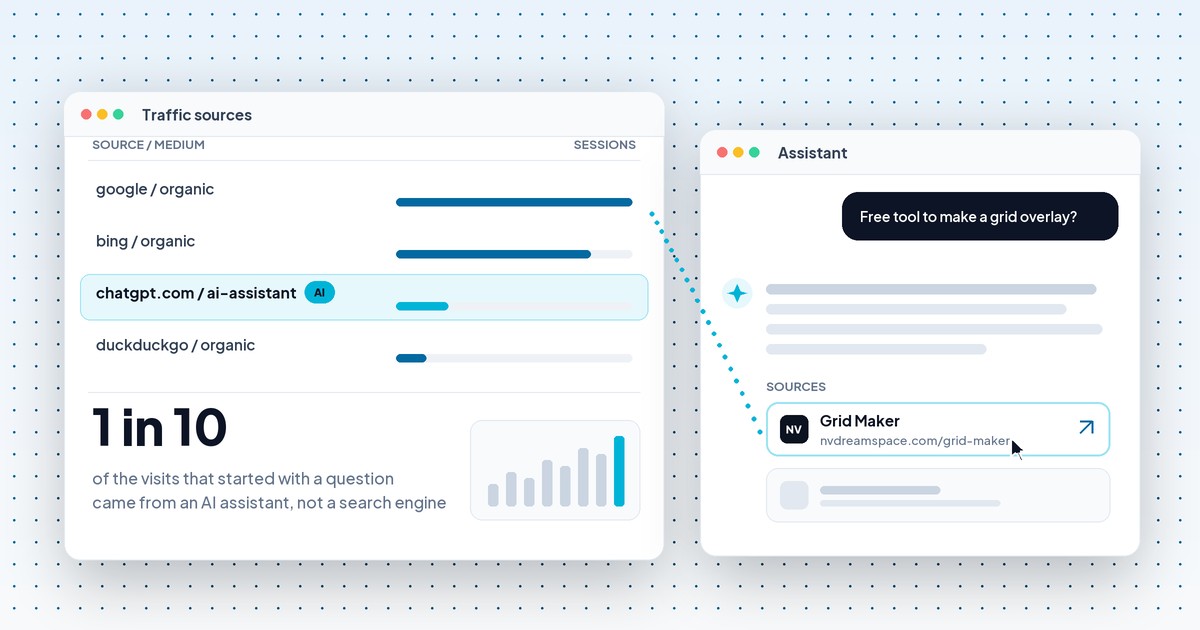
On this site, about one visit in ten that began with someone asking a question came from an AI assistant rather than a search engine, and almost all of those came from ChatGPT. That is real, it is worth measuring, and it is a long way from the end of search that most AEO pitches describe. Before you rebuild anything for answer engines, look up your own share. It takes ten minutes, and it will probably be smaller than the noise around it.
AEO, answer engine optimisation, is the idea that you should shape your pages so AI assistants quote them and link to them, the way SEO shapes pages for search results. The colleague who forwards me productivity articles has moved on to it entirely. Every one of them says the same two things: search is collapsing, and you need a new strategy for what replaces it. Neither article had a number from an actual website in it, so I went and got ours.
Match what you see to what it means
Before the numbers, the part most people get wrong when they go looking. AI traffic shows up in your analytics in a few different shapes, and only one of them is labelled honestly. Ordered by how often each one is the thing you are actually looking at.
| What you see in your analytics | What is probably going on | Worth acting on? |
|---|---|---|
| A source called chatgpt.com, as a referral or an AI assistant | Someone clicked a source link inside a ChatGPT answer | Yes. It tells you which pages get cited. |
| Google visits flat while impressions in Search Console climb | Your page is shown, often next to an AI summary, and fewer people click through | Partly. You can make the answer clearer. You cannot make people click. |
| Direct visits landing on deep pages nobody would bookmark | Some of it is visits whose source was stripped on the way, from apps and assistants among others | Only to note it. You cannot tell which part is AI. |
| Other assistants by name, such as Perplexity, Gemini, Copilot or Claude | The same as the first row, from a different product | Yes, once there are enough of them to read |
| No AI sources at all | Either nobody is citing you yet, or the visits are arriving as direct | Check that crawlers can reach you before concluding the first |
The first row is the only one you can count with any confidence, and it is the one I used for everything below. ChatGPT adds utm_source=chatgpt.com to the source links it shows, which is described in OpenAI's publisher FAQ, so its visits arrive carrying a label. Other assistants are not all as tidy about it.
Read our numbers before anyone else's
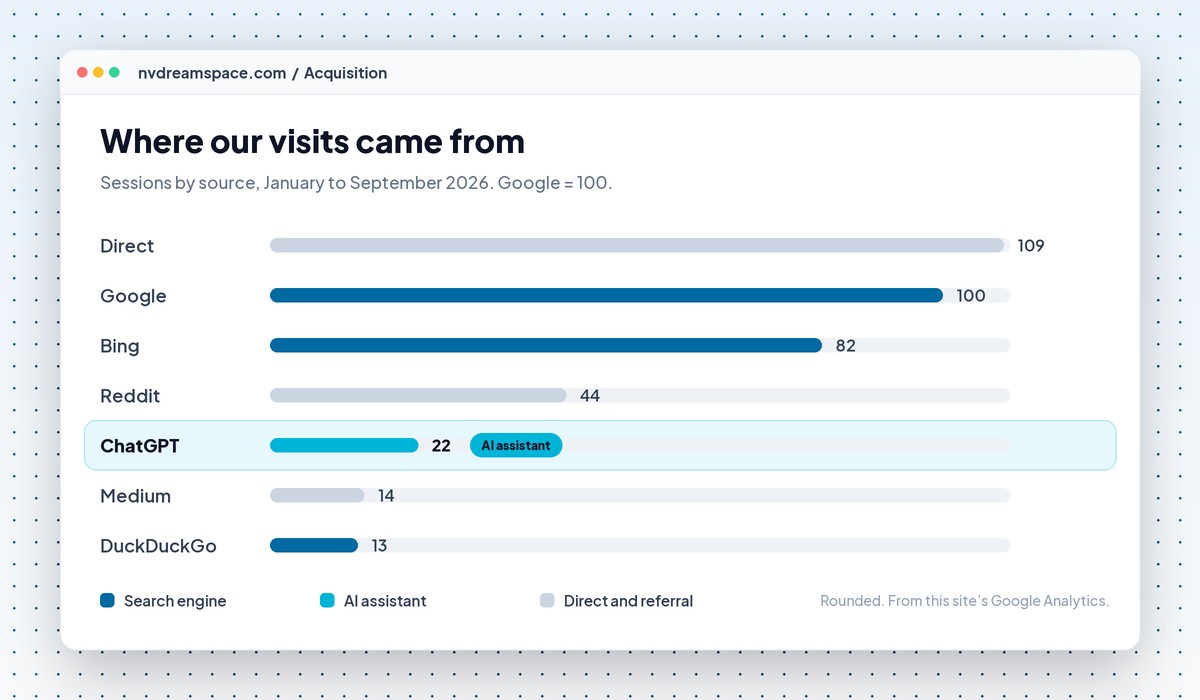
These are from this site's Google Analytics, January to the end of September 2026. I have shown them as shares and as an index against Google rather than as raw counts, partly because the raw counts are ours to keep and partly because the shape is the useful part.
Five things in there are worth saying plainly.
- About one in ten. Add up the visits from Google, Bing, DuckDuckGo and ChatGPT, everything that started with someone typing a question. ChatGPT is about ten percent of that.
- About four percent of people. Of everyone who found the site this year, roughly four in a hundred arrived first through ChatGPT.
- One assistant, not a category. ChatGPT is the only AI source in our top seven. If Perplexity, Gemini, Copilot or Claude sent anybody, it was fewer than the smallest row in that chart.
- Ahead of a search engine. ChatGPT sent more visits than DuckDuckGo and more than Medium, and about half what Reddit did.
- They came back more. People who first arrived from ChatGPT averaged nearly 1.8 visits each, against about 1.5 for people who first arrived from Google or Bing. Those two figures come from slightly different reports, so treat it as a hint rather than a finding.
The honest version is that this is a small site, and a share measured on a small site moves around. I would not stake much on ten percent being exactly ten. I would stake quite a lot on it not being fifty.
See why everyone is talking about it now
The idea is not new. What changed is that the biggest search products all grew answer boxes within a few months of each other, and somebody put a prediction with a number in it on the front of the conversation.
- February 2024: Gartner predicted that traditional search engine volume would drop 25 percent by 2026, and described generative AI as a substitute answer engine.
- May 2024: Google began rolling out AI Overviews to everyone in the US, putting a written answer above the links.
- October 2024: OpenAI launched ChatGPT search, answers with links to the sources they came from.
- July 2025: Pew Research Center published browsing data from 900 US adults showing what an AI summary does to clicks.
That last one is the measurement in the middle of all the predictions, and it is the reason I take the subject seriously rather than filing it with every other thing my colleague forwards.
Put those next to our numbers and the picture is less dramatic than either camp would like. AI answers do take clicks away from the results page, and that is measured. A small site can also get a real trickle of visits from being cited, and that is measured too, by us. Neither of those adds up to search disappearing this year, and our own visits rose through the year rather than fell.
Rule these out before you buy anything
Four checks on your own analytics. Each takes a few minutes and either clears or does not. These are written for Google Analytics 4, because that is what we use, but every analytics tool has the same reports under different names.
- Find the assistants by name. Open Reports, Acquisition, Traffic acquisition, and change the first column to Session source / medium. Search the table for chatgpt, perplexity, gemini, copilot and claude. Ours shows chatgpt.com with the medium ai-assistant; on many sites the same visits appear as chatgpt.com / referral.
- Divide by search, not by everything. Take the AI sessions and divide by search engine sessions plus AI sessions. Dividing by total traffic makes the number look smaller than it is, and dividing by Google alone makes it look bigger. The comparison that matters is with the other ways people ask questions.
- Check where they land. Add Landing page as a second dimension on the AI rows. If they land on the same pages Google sends people to, AEO is not a separate project for you. It is the same pages, read by a different machine.
- Look at direct, and do not count it. Find deep pages with a lot of direct traffic, pages nobody bookmarks or types in. Some of that is visits whose source was dropped on the way, and some of those will be from assistants. Write it down as unknown. Adding it to the AI number is how small sites end up with impressive slides and wrong decisions.
If step one comes back empty, check one more thing before deciding nobody is citing you. ChatGPT search looks for pages with a crawler OpenAI calls OAI-SearchBot, listed in its crawler documentation. A robots.txt that blocks it keeps your pages out of those answers. Nobody does this on purpose. It usually arrives inside a template that blocks every bot it does not recognise.
Change what helps both, and leave the rest
Did AEO remove the work, or move it? Mostly it moved the reading. The assistant reads your page so the person does not have to, which is why the click rate falls. For you, the useful question is which changes help a page whether a person or an assistant is reading it, because those are the only ones worth the time when the second audience is a tenth the size of the first.
- Answer the question in the first paragraph. It is what people skimming want, and it is what gets quoted.
- Use the title the reader would type. A question in plain words beats a keyword string for both.
- Keep FAQ markup identical to the questions on the page. Structured data that disagrees with the visible text is a reason not to trust either.
- Let the crawlers in, as above.
And the things I would not do on our numbers: buy a tool that scores your "AI visibility", rewrite every page into questions and answers, or start a second content calendar for answer engines. Each one adds a dashboard and a process to feed it. At one visit in ten, that is a lot of new work in exchange for a small share, and the four changes above already cover most of it. Run the checks again in six months. If the share has doubled, the calculation changes, and I will happily be wrong about it in public.
What I had wrong
I expected the AI number to be one of two things: zero, or the headline. It was neither, and I had not prepared an opinion for "real but modest", which says something about how much of the coverage I had absorbed without noticing.
I also expected a spread of assistants, a little from each. It is one. For practical purposes, AEO on this site currently means being a page ChatGPT is willing to link to, which is a narrower and more checkable thing than the word suggests.
And I had not looked at Bing in months. It sends us over three quarters as many visits as Google. I spent an evening reading about answer engines before noticing a search engine I had been ignoring the whole time, which is exactly the kind of thing I would point out in somebody else's process.
Frequently asked questions
What is AEO?
Answer engine optimisation: making pages easy for AI assistants and AI search summaries to quote and link to. In practice it overlaps heavily with ordinary SEO. Clear answers near the top, plain titles, accurate structured data, and pages that crawlers are allowed to reach.
Is AEO different from SEO?
Less than the name suggests. The audience reading the page is different, a model rather than a person scanning results, but the pages that get cited tend to be the pages that already answer the question clearly. The main new task is checking your share of AI visits and making sure AI crawlers are not blocked.
How do I see ChatGPT traffic in Google Analytics?
Open Reports, Acquisition, Traffic acquisition, set the first column to Session source / medium and search for chatgpt. ChatGPT tags the source links it shows with utm_source=chatgpt.com, so its visits appear under that source, usually with the medium referral or ai-assistant.
Why does some AI traffic show up as direct?
When a visit arrives without a referrer or a tracking tag, analytics has nothing to attribute it to and files it as direct. Some apps and assistants drop that information, so part of your direct traffic may come from AI. There is no reliable way to separate it, so note it rather than count it.
The site figures are from this site's Google Analytics for January to September 2026, rounded, and shown as shares or as an index against Google rather than as raw counts. Outside figures link to where they were first published.