
Short answer: Google treats most of your meta tags as suggestions rather than instructions. It rewrites your title on roughly six pages in ten, rewrites your description more often than that, has ignored your keywords tag since 2009, and treats your canonical as a hint it is free to overrule. The tags it does obey without argument are the robots directives, which is unlucky, because those are the ones people switch on by accident.
Work down this table. The symptom column is what you are seeing in the results, and the cases are ordered by how often each one turns out to be the real answer.
| What you are seeing | Most likely cause | Is it fixable |
|---|---|---|
| A different title than the one you wrote | Title rewritten, usually toward the H1 or a shorter version | Often, by fixing what it is rewriting away from |
| Description text pulled from the middle of the page | Snippet rewritten to match the query | No, and it is usually the better snippet |
| Your old title or description is still showing | Page not recrawled since you changed it | Yes, by waiting |
| No description at all under the title | A nosnippet or max-snippet:0 directive |
Yes, and you probably did not set it deliberately |
| Several pages sharing one title or description | A template writing the same tag everywhere | Yes, and this is the one worth your afternoon |
| A URL ranking that is not the one you set as canonical | Canonical is a hint, and Google disagreed with it | Sometimes, by removing the thing it disagrees with |
| Your keywords tag has never done anything | Google has ignored it since 2009 | No, and nothing is broken |
The two it rewrites, with the numbers
Titles and descriptions are the two tags that actually appear in the results, and both get replaced more often than they get used.
Different studies, different methods, same conclusion. Most of the time the tags you wrote are not the tags anybody reads.
For descriptions the reason is unglamorous. You write one sentence. That page then has to answer every search that lands on it, and there are usually dozens. A page about pulling text out of PDFs gets somebody searching for scanned documents, somebody searching for a bulk extractor, and somebody searching for why their line breaks came out wrong. One sentence cannot be the right preview for all three, so Google finds a passage that fits the specific query and shows that instead.
Titles get rewritten for a narrower set of reasons, and they are ones you can act on. The Zyppy numbers are blunt about it. Titles over 70 characters were rewritten almost every time, very short titles were rewritten almost every time, and the lowest rewrite rate sat between 51 and 60 characters. Boilerplate is the other trigger. If every title on the site ends with the same pipe and the same brand name, Google will often drop it and use your H1 instead.
What Google actually does with each tag
Most of the confusion here comes from treating all of these as one category. They are not. Three of them are suggestions, one is ignored outright, and one group is a real instruction.
| Tag | What Google does with it |
|---|---|
<title> |
Main input for the title link, rewritten about 61% of the time. Also a genuine ranking input, unlike the rest of this table |
meta description |
Used when it happens to fit the query, rewritten more often than not. Not a ranking factor |
meta keywords |
Nothing at all. Google said so publicly in 2009 and has not changed position since |
rel="canonical" |
Treated as a strong hint. Google picks its own canonical and can choose a different URL than the one you named |
meta robots |
Obeyed. noindex, nosnippet and max-snippet are instructions, not suggestions |
og: and twitter: |
Nothing in search results. Used verbatim by social platforms and chat apps |
Read that column again and the pattern is hard to miss. The tags people spend their time writing are the ones Google feels free to overrule, and the tags nobody thinks about are the ones it follows exactly.
Rule these out first
Before accepting the normal explanation, four checks. They take about ten minutes and two of them catch problems that are entirely yours.
-
Look at the served HTML, not the editor.
View source on the live page and search for
<title>andname="description". A CMS field that looks filled in and a tag that is actually published are different things, and two plugins writing the same tag will quietly disagree with each other. -
Check the robots tag for a snippet directive.
In the same source, look for
nosnippetormax-snippet:0. Either one tells search engines to show no description at all. Almost nobody sets these on purpose. They arrive through a plugin default, a theme, or somebody hardening the site. - Confirm the page has been recrawled. If you changed the tags recently, Google may simply be showing what it last saw. The URL Inspection tool in Search Console tells you when the page was last crawled, which settles it in about thirty seconds.
- Compare the page against its neighbours. Pull the titles and descriptions for a whole section into one place and read down each column. This is the check nobody runs, and it is the one that finds the templated tag repeated across forty pages.
Worth separating two things that get confused. A rewritten description is not a ranking problem, because the description has not been a ranking factor for years. A rewritten title is a different matter: the title element is a real input, so when Google replaces yours it is telling you something about the one you wrote. Both can move click through rate in either direction, which is a separate measurement and belongs in the Search Console performance report rather than in your assumptions.
Where your tags run exactly as written
The honest version is that none of this is wasted, it is doing less than the advice implies. Three places your tags run verbatim, with no algorithm choosing.
Social cards. Paste the link into Slack, LinkedIn or a group chat and the preview takes your og:title and og:description, or falls back to the title and meta description. Whatever you wrote is exactly what appears, at the moment somebody is deciding whether to open it.
Feed readers and aggregators. Anything reading your tags directly takes them at face value, with no rewriting at any point.
The searches your wording happens to fit. A third of results is not nothing, and on titles it is closer to four in ten.
Seeing what your pages actually publish
The fourth check above is the one that needs a tool, because duplicates are invisible one page at a time. You never see two pages side by side in normal use, which is exactly why a templated title can sit on forty pages for a year without anybody noticing.
Our Meta Tag Extractor reads a page, a set of related pages in the same section, or a whole site, and puts the titles, descriptions, keywords and canonicals into one table with the character counts marked. Below is that tool run against this site's own blog section.
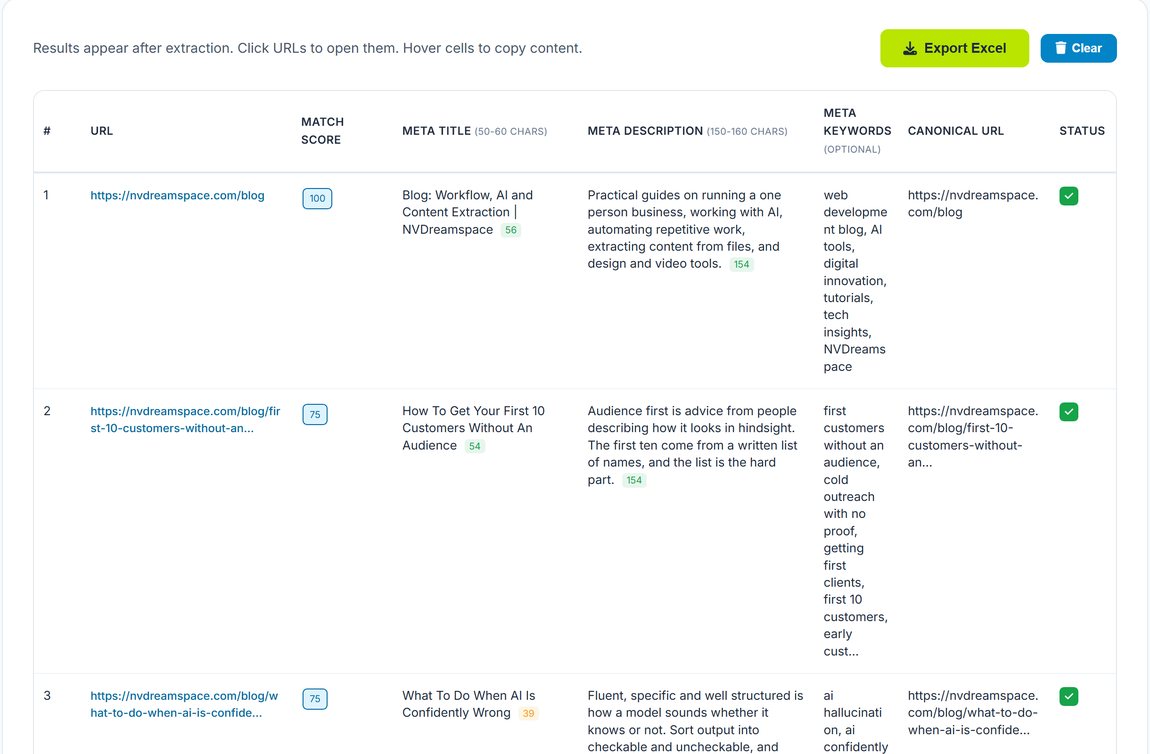
The character counts matter more than they look. Given what the Zyppy numbers say about length, a title column sitting above 70 tells you which pages are being rewritten before you check a single result.
Export it, sort by whichever column you are auditing, and anything repeated groups itself. On most sites that is the entire audit.
What I had wrong
I used to treat the description as the whole job, and the character limit as the whole of the description. Get under 160, make it read like a sentence, tick the page off. There was a spreadsheet, which will not surprise anyone who has read anything else I have written here.
Two things were backwards. The first is that I was polishing the tag Google is least likely to use, and barely looking at the title, which is the one it both rewrites and counts. The second is that I was working one page at a time and never comparing pages against each other. The pages I fussed over were mostly fine already. The real problem, found much later than it should have been, was a block of pages sharing one templated title, and no amount of careful writing on the good pages was ever going to surface that.
Which is fine, except it means the advice I was following had me spending the time in the wrong column. The failures here are structural rather than editorial, and structural problems are invisible one page at a time.
See what your pages are publishing
Titles, descriptions, keywords and canonicals for a page, a section or a whole site, in one table with the character counts marked. Free, no account.
Open the Meta Tag ExtractorFrequently asked questions
Why is Google not showing my meta tags?
Because most of them are suggestions rather than instructions. Google rewrites about 61 percent of titles and the majority of descriptions, ignores the keywords tag entirely, and treats canonical as a hint. Before assuming that is what happened, rule out the causes you control: a nosnippet or max-snippet:0 directive, a page not recrawled since you changed it, and tags that are missing or duplicated across pages.
Why is Google changing my title tag?
Usually length or boilerplate. A Zyppy study of 80,959 titles found the lowest rewrite rate between 51 and 60 characters, with titles over 70 characters rewritten almost every time. The other common trigger is every page ending in the same brand suffix, which Google will often drop in favour of your H1.
How long does it take for new meta tags to appear?
They appear when the page is next crawled and reindexed, which is days to weeks depending on the site. Nothing you do makes that instant. Requesting indexing in Search Console for one important page is reasonable; doing it for forty pages is not, and will not speed anything up.
Does a rewritten title or description hurt my rankings?
A rewritten description costs you nothing in position, because it has not been a ranking factor for years. A rewritten title is worth more attention, since the title element is a genuine ranking input, so a rewrite is telling you something about the title you wrote. Both can move click through rate either way, which is a separate thing to measure in Search Console.
What is nosnippet and did I turn it on?
It is a robots meta value that tells search engines not to show any text snippet for the page. Most people never set it deliberately. It arrives through an SEO plugin setting, a theme default or a security header somebody added, so it is worth checking rather than assuming.
Do meta keywords do anything?
Not for Google. It stated publicly in 2009 that the keywords meta tag plays no part in web ranking, and that has not changed. Filling it in is harmless and pointless. The only reason to look at it is that some internal site search tools and a few smaller engines still read it.
How do I check the meta tags across a whole site?
View source works for one page. For a set of pages that gets old fast, and looking at pages one at a time hides duplicates, which are the most common real problem. Read them in bulk into one table, sort by the column you are auditing, and anything repeated groups itself.