
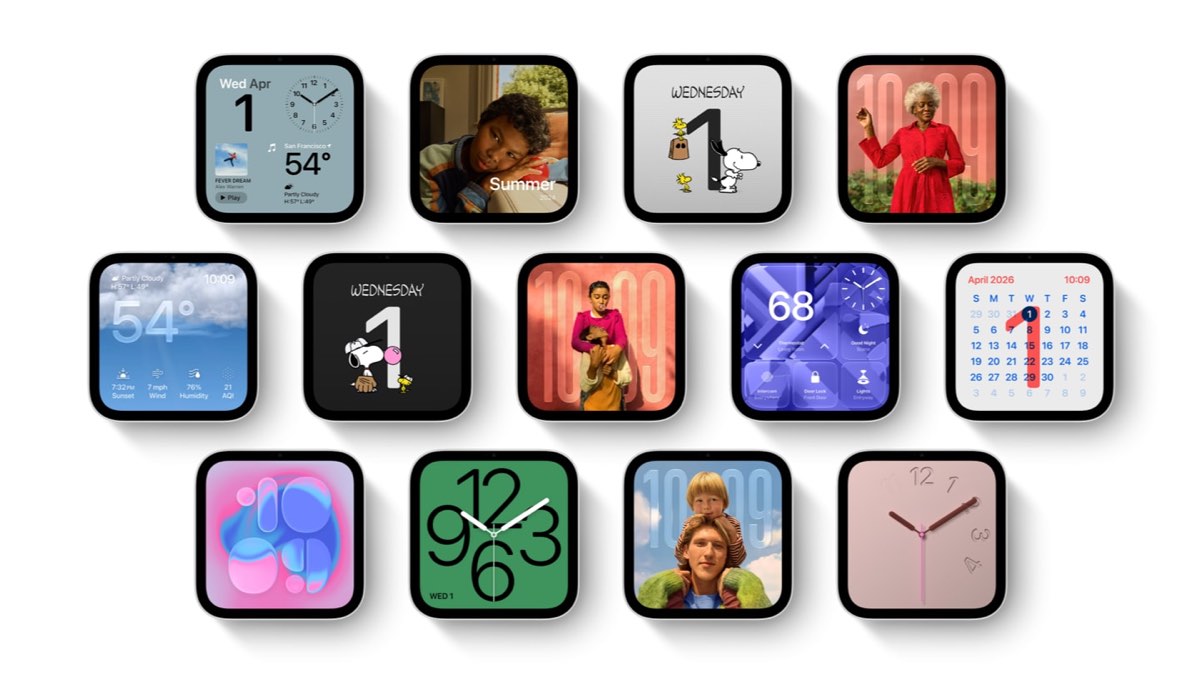
The picture I keep returning to from Apple's announcement last Tuesday is not the product shot. It sits further down the page: thirteen HomeView screens laid out in rows to show the faces you can choose from, and most of them are telling the time. Nine minutes past ten, mostly, the hour watch adverts have favoured for as long as I can remember. On a device Apple wants at the centre of your home, the first thing it shows you is a very good-looking clock.
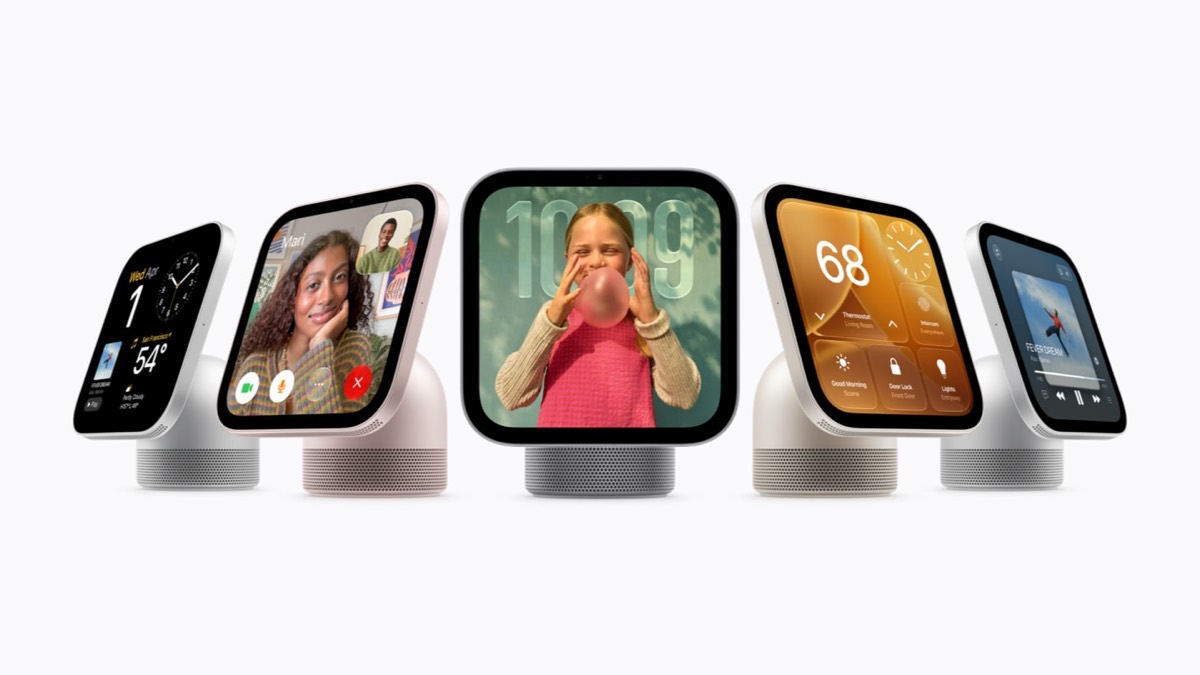
For anyone who missed it, HomeView is a square seven-inch screen on a domed speaker base, and it costs $299. Apple announced it by press release on 13 October, alongside a new HomePod mini, a new Apple TV 4K and a range of smart home accessories, rather than on a stage. It comes in four colours, or two if you buy the version that hangs on a wall, and it recognises up to six faces, so each person in the house gets their own home screen. It arrives on 13 November in the US, the UK, Canada, Australia, India and New Zealand, with Singapore and South Africa the same day. It is not coming to the European Union, because the new Siri it is built around is not available there.
I have not used one, and almost nobody outside Apple's briefings has lived with one yet. The early hands-on pieces, Gizmodo's among them, are impressed by how it is made and how it sounds, and I believe them. Apple rarely gets the object wrong. What I am less sure of is the life it is supposed to have once it is plugged in and the box has gone out with the recycling.
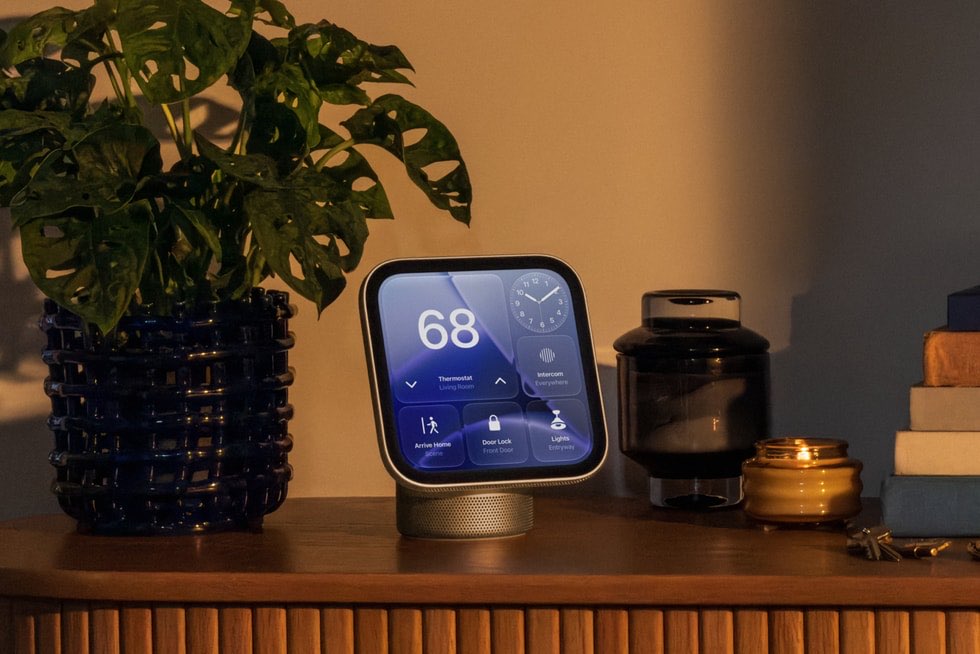
Apple's own photographs answer the question of who it is for by not quite answering it. Someone stirring a pot in a kitchen. Someone reading at a kitchen table with the screen beside the book. A sideboard at dusk with a plant, a candle and a thermostat reading 68 degrees, and nobody in the room at all. They are pictures of rooms more than of people, and I think that is the tell.
A product that knows who it is for usually shows you that person.
The six faces suggest a family, and that is the most interesting idea in the whole launch. Every shared screen in a house has the same problem: it belongs to everyone, so it is personal to no one. Greg Joswiak, who runs Apple's worldwide marketing, put the answer neatly when he said it "recognizes your face to shift from a household screen to your own experience." Walk up to it and it becomes yours. That is genuinely thoughtful, and I would like to see it work.
Then you read the footnotes, which is where the real product lives. Setting HomeView up, and giving each person their own space on it, needs a compatible iPhone or iPad. Your messages and calendar only appear when it recognises your face and your paired iPhone or iPad is nearby and recently unlocked. The richer Siri features want a device that can run Apple Intelligence, and some of them want one with 12GB of memory. So the household this is designed for is one where every person who counts already carries a recent iPhone, which is also a household where every one of those people has a better screen in their pocket than the one on the counter. Everyone else in the house, the child too young for a phone or the grandparent who comes on Sundays, gets the shared version: the photo album, the music, and the clock.
Which brings me back to the clock. I have watched smart displays arrive in friends' kitchens for years, and the ones I have seen mostly settle into the same two jobs within a few months: a photo frame, and a clock that also sets timers. Nobody plans that. It is what is left once the novelty of talking to a screen wears off and the screen is still there, switched on, in the corner of your eye. Apple seems to have looked at that pattern and decided to make the best possible version of it rather than find a way out of it. The faces are lovely. One puts your photos behind the time with a depth effect. A Snoopy face changes with the weather, the sport and the holidays. Another shows up to nine camera feeds at once. And in Apple's own picture of them, most lead with the hour.
I keep coming back to defaults, because that is where a device like this actually lives. Most days you will not open anything on HomeView. You will walk past it, and what it shows when you do nothing is the product. If that is mostly a beautiful clock, then $299 is a great deal of money for one. ABC's comparison puts Amazon's Echo Show 11 at $249.99 and Google's second-generation Nest Hub from $99.99, and both of those tell the time as well.
There is a quieter cost too. Apple's footnotes label Siri AI on HomeView a beta, and say some of its server-side features have daily limits and that expanded access may cost a fee in the future. Camera history needs an iCloud+ plan, and the written summaries of what happened on your doorstep need an eligible one. None of that is unusual now. It does mean the $299 on the box is the first payment rather than the whole of it.
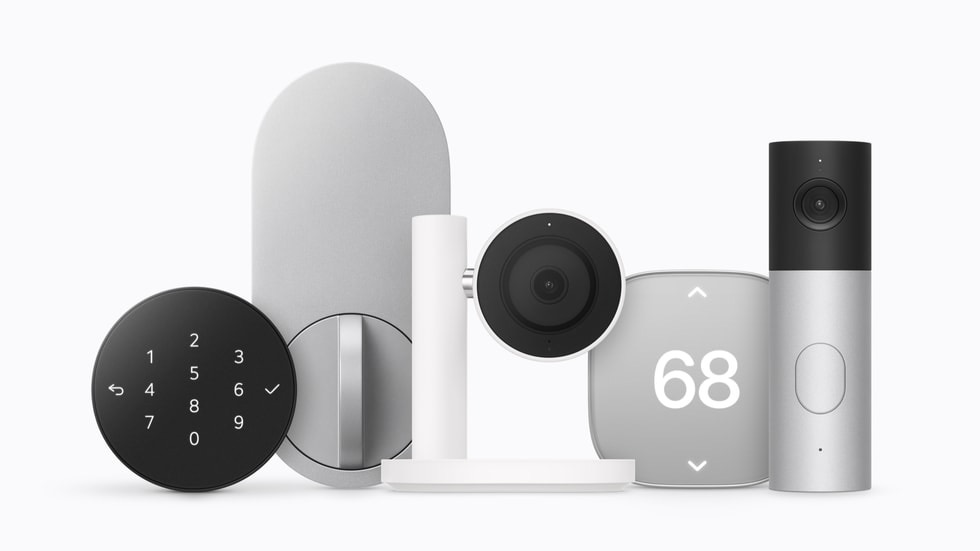
The piece of last Tuesday I find more convincing has nothing to do with the screen. Alongside HomeView, Apple introduced Apple Home Collection, a set of cameras, a video doorbell, a deadbolt, thermostats and sensors designed with LG Electronics and Schneider Electric. LG makes most of it: all four cameras, the lock, a thermostat and a temperature sensor, each carrying LG's name, from $39.95 for the sensor to $399.95 for the floodlight camera. LG's own release says the two companies worked on them together from the earliest planning, and that they work in LG's ThinQ app as well as in Apple Home. The range arrives in the US and Canada in December, with the cameras and the doorbell reaching the UK too, and some pieces wait until early 2027.
It is worth being precise here, because I have seen this described as an appliance deal. It is not, or not yet. LG's release mentions its experience with home appliances, but nothing in it, or in Apple's, says your LG fridge or washing machine is joining Apple Home. These are accessories, the small things people actually buy when they start making a house smart, and that is exactly why the move makes sense. The worst part of a smart home has always been the shopping: standing in front of a shelf of doorbells, each with its own app and its own subscription, trying to work out which one will still be supported in three years. Apple picking one for you, with LG building it and an installer from ADT available through Apple's stores, takes most of that away.
It also ties the knot tighter. The lock, the thermostats and the sensors work over Matter, so they would carry on working in another system. Apple's release says nothing about Matter for the cameras, which need a home hub, meaning a HomeView, a HomePod or an Apple TV, for many of their features, and iCloud+ for their recordings. That is where the LG partnership and the screen meet. The accessories make HomeView more useful, HomeView makes the cameras more useful, and a household that buys both has made a fairly large decision about whose house it is. For people already inside Apple's world that is probably fine, and even pleasant. It just makes leaving later a much bigger job than it would have been.
So I am not convinced, though I would like to be. I can see HomeView being very good in one particular home: full of recent iPhones and Apple Home accessories, in one of the handful of countries where it is sold, with someone who cooks often enough to want a recipe on the counter. Outside that home I struggle to see who it is for. Inside it, I suspect that within a few months it settles into the nicest clock in the kitchen, which is a lovely thing to own and a strange thing to have built a new kind of device around. I would be glad to be wrong about that in a year.
How this was put together: every specification, price, date and requirement here comes from Apple's newsroom releases for HomeView and Apple Home Collection and from LG's release, all published on 13 October 2026, with competitor prices from ABC News. We have not used HomeView, and nobody outside Apple had a review unit when this was written. All images are Apple's, from those releases.