

A public slide deck states a company's positioning more plainly than its website does. Decks are written to persuade a room, so the hedging gets stripped out, and what remains is the argument the company actually believes. Getting that text out in one pass, with the slide boundaries intact, is the difference between reading a deck and analysing forty of them.
The obstacle is rarely the analysis. It is that copying a deck slide by slide is dull enough that people stop after the first few, and that most export routes flatten the structure that carried the meaning.
Why decks are worth reading at all
A website has to work for everybody who lands on it, so it drifts toward language that offends nobody. A deck is aimed at one room, for one purpose, with somebody standing next to it who will be asked questions. That constraint produces plainer claims.
Several kinds are usually public and worth the effort. Earnings presentations show what a company has decided to be measured on. Conference talks show what it wants peers to think it is good at. Sales decks, when they surface, show the objections it expects. Training material, where it is published, shows how the work is actually done rather than how it is marketed.
None of that requires anything private. It requires reading what companies have already chosen to publish, in a format most people find too tedious to process at volume.
What usually gets lost
Slides are not paragraphs. Meaning sits in the arrangement as much as the words, and most extraction routes throw the arrangement away.
Copying by hand loses the slide boundaries, so twelve separate claims arrive as one run-on block and you can no longer tell which belonged together. Exporting to plain text often drops speaker notes entirely, which is where the honest version of a claim frequently lives. Anything that reads only the visible text misses the appendix slides, and the appendix is where the numbers usually are.
Order carries argument. A deck that builds to a claim reads completely differently from the same sentences in a list.
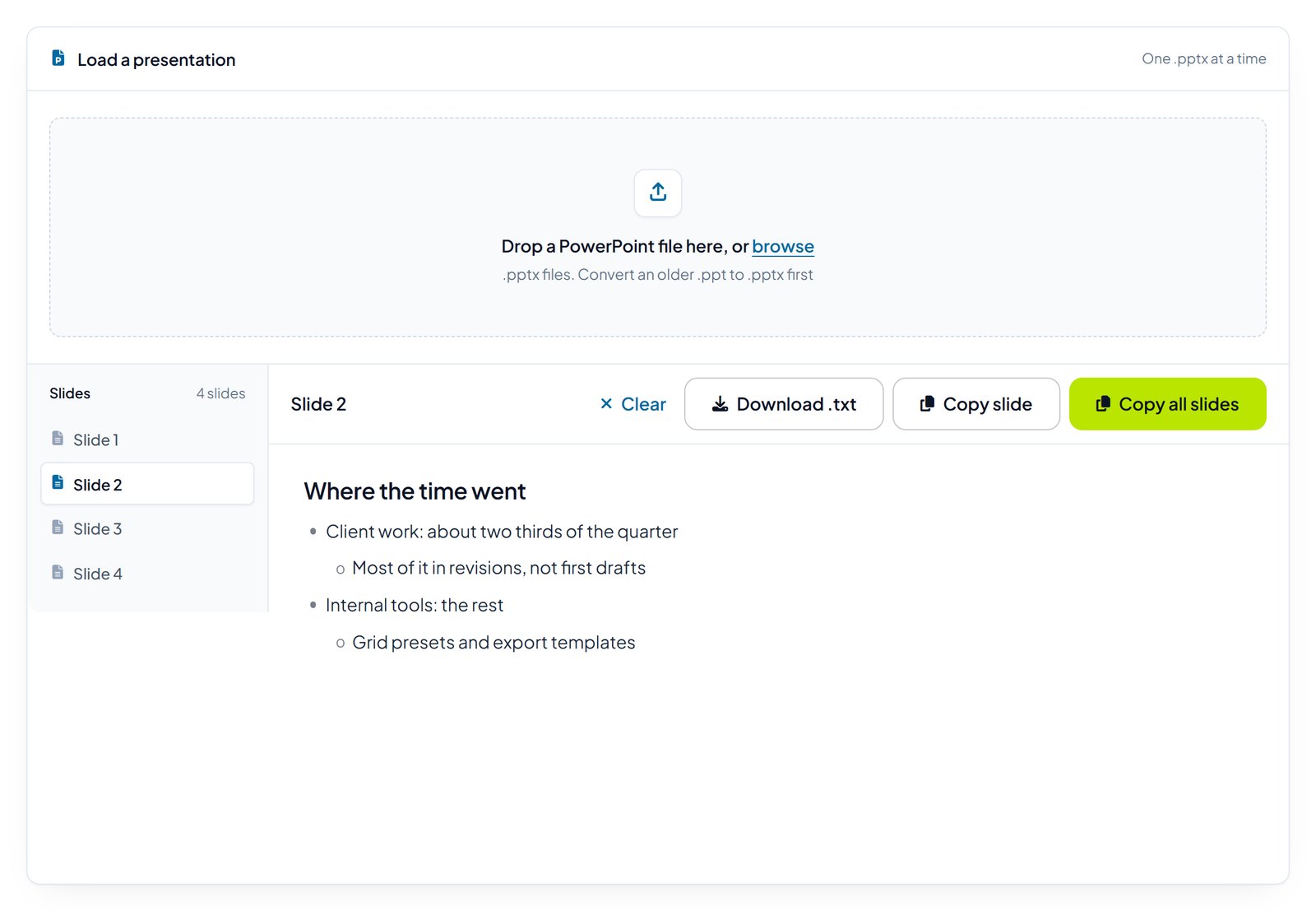
What you want back is the text with the slide structure still visible: which slide, in what order, with notes attached. Our PowerPoint Content Extractor does that in one pass, and it reads the file inside your browser rather than uploading it, which matters if the deck is not yours to distribute.
Reading a deck properly
Once the text is out, a few passes get most of the value.
Read the titles alone, in order. Slide titles are a company's own summary of its argument. Strung together they usually reveal the structure faster than reading the body text does.
Find the one number they repeat. Most decks have a figure that comes back three or four times. That is the metric the company has decided to be judged on, which tells you what it is optimising for.
Read the speaker notes against the slide. Where they diverge is interesting. A confident slide with a heavily caveated note is a claim the presenter did not want to defend unaided.
Look at what is in the appendix. Material moved to the back is material somebody judged necessary but not persuasive. That judgement is informative on its own.
Comparing across companies
One deck is an anecdote. The comparison is where this becomes useful, and it needs the same discipline as any other competitor reading: decide the question before you collect.
Questions that hold up across a set of decks include which problem each company claims to solve, what evidence each offers for its central claim, which objections each pre-empts, and what each treats as obvious enough not to explain. That last one is the most revealing, because assumptions a company shares with its audience tell you who it thinks the audience is.
Read the deck against the same company's public pages too. Where the deck is more specific than the website, the website is being cautious. Where the website claims more than the deck does, the deck is the more reliable document.
Using a model on the extracted text
A model is good at the sorting: grouping similar claims across many decks, pulling every sentence that mentions a particular topic, arranging scattered wording into a table. It is not good at telling you what any of it means for your market.
Keep the questions narrow and insist on quotes.
Grouping: "Here is text from six conference decks. List the distinct problems each claims to solve, quoting the slide title and the sentence. Do not infer anything not stated."
Evidence: "For each claim in this deck, quote any supporting figure or source given on the same slide. Mark claims with no support."
Change over time: "These two decks are from the same company a year apart. List claims present in one and absent in the other, quoting both."
Asking for the quote is what keeps this honest. A claim that carries its source sentence can be checked immediately, and an invented one fails a search rather than reaching your summary unchallenged. That is the same reasoning behind writing a specification a model can follow.
Where the limits are
Use decks that are genuinely public: published on a website, filed with a regulator, presented at an open conference. A deck shared with you under an agreement, or one that turns up somewhere it was not meant to, is not material for this regardless of how easy it is to open.
Read for positioning, not for reuse. Copying somebody's slide wording into your own material is a copyright problem before it is a strategy problem.
Note the source and the date for every deck. Positioning moves, and a comparison assembled from decks two years apart says less about the market than it appears to.
Get the whole deck out at once
Our PowerPoint Content Extractor pulls the text from a presentation in one pass, keeping the slide structure and the speaker notes. It reads the file inside your browser, so the deck is never uploaded anywhere. Free, and no account.
Try the PowerPoint Content ExtractorWhere to start
Take one company you already follow and find their most recent public deck. Extract it, read the titles in order, and write down the single claim the whole thing is built around. That takes about twenty minutes and it will tell you whether the exercise is worth repeating across a set.
If it is, the second pass is the useful one: the same company a year earlier, so you are reading the change rather than the snapshot.
How this was put together: this describes how we read public decks ourselves. It is not research, and we have quoted no figures on how much time extraction saves or how many decks an analyst can process, because that depends entirely on deck length and how much of the value sits in the notes.